Prediction Markets Have a Visibility Problem. Here's the Fix
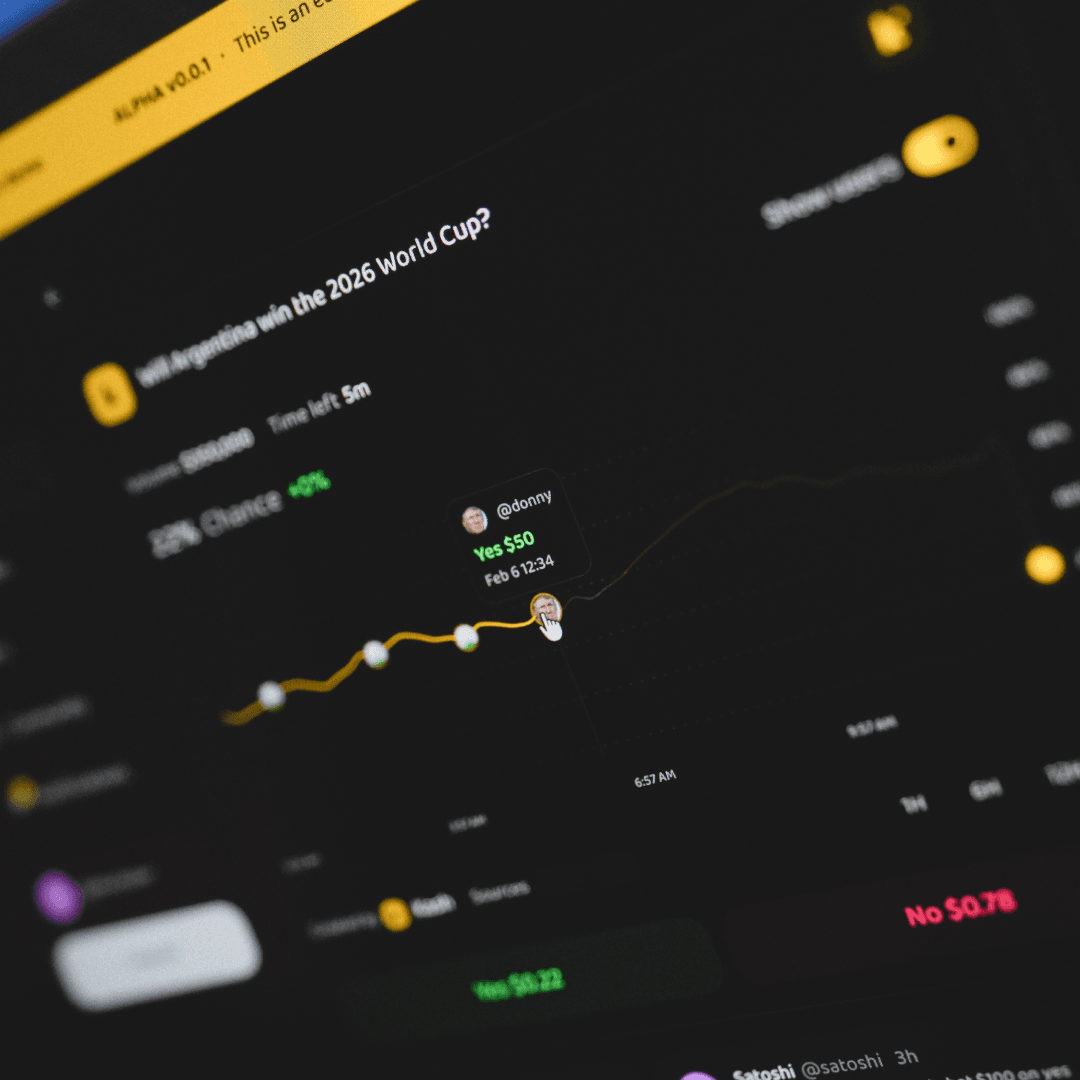
TL;DR: Anyone can tweet "France wins" when they’re favorites. But calling it in March, when the market priced them at 20%, and backing that take with skin in the game is a different level of ball knowledge. While platforms like Kalshi keep your winning trades locked in a private dashboard, Kash is a social prediction market that turns your trades into verified, shareable status. By quote-tweeting @kash_bot, you aren't just posting a take; you’re timestamping a position against the crowd that your mates can see, verify, and never ignore.
[Last updated: March 18, 2026]
Your Best Call Is Already Buried
We’ve all seen it: the guy in the group chat who claims he "called the upset" after the final whistle. Without a receipt, it’s just noise.
A tweet is easy to copy-paste or delete. But a prediction market trade is an immutable record of what you believed, exactly when you believed it, and, most importantly, what the market price was at that moment.
If you backed Spain in March, you weren't just guessing; you were taking a calculated position when the consensus was against you. On standalone platforms like Kalshi or Polymarket, that elite bit of business stays hidden in a private account. On Kash, your stake is your status.
What Is a Prediction Market (and Why They Often Miss the Moment)
Think of a prediction market like a live scoreboard for what people actually believe will happen.
Someone asks: “Will France win the 2026 World Cup?” The market immediately shows a number (say 18%) reflecting the crowd’s collective belief. That’s not a random guess; it’s the result of thousands of people putting real stakes behind their forecasts.
If you think France is underrated, you can “take a position” by staking some money. When the event resolves:
If France wins, your stake pays out, rewarding you for spotting what others missed.
If France loses, you lose what you put in.
The magic is in the signal. The market continuously aggregates everyone’s stakes into a single probability, showing what the crowd really thinks, and studies from institutions including the University of Iowa suggest these probabilities often outperform polls, pundits, or expert models.
The key insight: markets capture probability, but they don’t automatically make you visible to your audience. Your correct call can still vanish, unless you’re on a platform like Kash.
How Prediction Markets Actually Work (and Where They Break Down)
Standalone platforms are built for traders, not fans.
Polymarket looks like a crypto exchange.
Kalshi feels like a Bloomberg terminal.
They assume you’ll leave your social feed, open another app, navigate to the right market, place your position, and then somehow share it back to the conversation you just left.
That’s five steps too many. And every step is friction that breaks the prediction impulse.
The Screenshot Problem
Here’s the real test: can you share your prediction while the moment is happening?
On Kalshi, it requires: open app → find market → place position → screenshot → switch to X → paste → post. Six steps. By the time you finish, the conversation has moved on.
On Polymarket, it's worse. The interface is designed for DeFi traders, not football fans. Your mates aren't going to click a Polymarket link. They'll scroll past it.
The fundamental problem: the prediction lives in one place, the conversation in another. Your forecast exists, but it isn’t visible to the people who matter.
The Evolution: From Standalone to Social-Native
Prediction markets have evolved in three waves.
Wave 1: Standalone platforms. Intrade, PredictIt. Desktop-first, slow, limited markets. Built for political junkies, not sports fans.
Wave 2: Crypto-native platforms. Polymarket, Kalshi. Faster settlement, more markets, but still disconnected from social. The prediction lives inside the app. Sharing is an afterthought.
Wave 3: Permissionless social-native platforms. The prediction lives where the conversation already happens. No app switching. No screenshots. The forecast is the social post.
Kash is the first social-native prediction market built directly on X. You see a market in your feed. You quote-tweet @kash_bot with your position. Done. Your prediction is public, timestamped, and verifiable, and it's already in front of your followers.
The Fade mechanic takes this further. When you see a bad take from a pundit or a rival fan, you don't argue in the replies. You Fade it, taking the opposite position with one click. Your Fade generates a new quote-tweet that spreads to your followers, turning every wrong call into an opportunity to prove you knew better.
How the Best Prediction Markets Compare
Kalshi and Polymarket remain strong tools for traders: deep liquidity, solid price discovery. But for fans who want to prove their insight publicly, Kash operates in the right space: your social feed.
Feature | Kalshi | Polymarket | Kash |
|---|---|---|---|
Where predictions live | Standalone app | Standalone app | Your X feed |
Steps to share a forecast | 6 (screenshot→switch→paste) | 5+ (copy link→switch→paste) | 1 (quote-tweet) |
Market creation | Platform-controlled | Platform-controlled | Permissionless; 30 seconds via app |
None | None | 30% of fees from your market | |
Verification | Internal ledger | On-chain | On-chain + Proof of Intelligence card |
Social integration | None native | None native | Built into X; social-native |
Micro-narrative markets | Limited catalogue | Moderate catalogue | Permissionless; any moment, any story |
Why Invisible Predictions Cost You
There's a real cost to predictions nobody can verify.
Every time you make a correct call that disappears, you lose status. You lose the "I told you so" moment. You lose the group chat credibility that compounds over time. The analytical fan who's consistently right should have a track record. Instead, they have a timeline full of buried tweets.
Kash's Proof of Intelligence system solves this permanently. Every correct prediction generates a verified, on-chain PoI card. A shareable receipt proving you called it, when you called it, and at what price. It's the difference between claiming you called Spain's Euro win and proving it with a timestamped, immutable record.
Prediction as status. That's the shift.
The World Cup Changes Everything
The 2026 World Cup starts June 11. It's the largest ever: 48 teams, 104 matches, three host nations. The volume of predictions, debates, and group chat arguments will be unprecedented.
Imagine this: 83rd minute, VAR check, group chat exploding. Someone says: “No way that’s given.” On Kash, there’s already a flash market: “Penalty given? Yes/No.” You Fade it, staking on the outcome you believe. Two minutes later: penalty given. Your prediction is public, timestamped, and verifiable, no arguing, no screenshots, just proof.
Standalone markets can’t move this fast. Kash lives in the moment.
Make Your Call
Your predictions shouldn't disappear. Your correct calls should build a public track record, not evaporate into the timeline.
Kash is live on testnet now and Mainnet launches mid-April. Quote-tweet @kash_bot with your first prediction using test USDC. No app download. No deposit screen. Twelve seconds from your feed to a verified, shareable prediction.
Your mates are already wrong about the World Cup. Prove it.
FAQ
What is a prediction market?
A prediction market is a platform where users forecast real-world outcomes by trading positions at a market price between 0% and 100%. The crowd's collective forecast consistently outperforms polls, pundits, and expert models.
How do prediction markets work?
You take a position at the current market price. If the outcome you predicted happens, your position resolves at 100% and you earn the difference. If it doesn't, you lose your stake. Kash adds a social layer: you predict by quote-tweeting @kash_bot directly on X.
What is the difference between Kalshi and a social prediction market?
Kalshi is a standalone app: your predictions live inside the platform, disconnected from your social audience. A social prediction market like Kash is built into X. Your forecast is your social post. No app switching, no screenshots, no friction.
Which are the best prediction markets for the World Cup?
For the 2026 World Cup, the best prediction markets will offer speed (real-time micro-narrative markets), social integration (shareable predictions), and permissionless market creation (any moment, any market). Standalone platforms offer deep liquidity but lack social features.
Can I create my own prediction market?
On Kash, yes. Any user can create a market through the app in 30 seconds and earn 30% of the revenue share from fees generated by that market. No gatekeeper.

