Public Testnet Week 1: The week the internet priced a Sam Altman meme
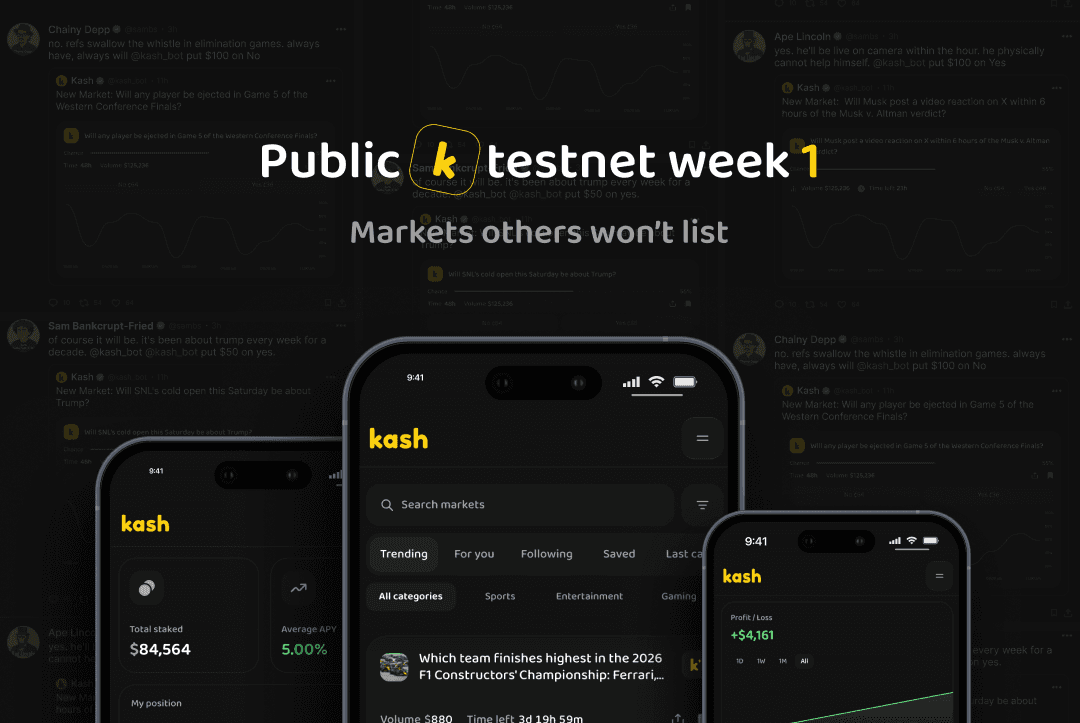
TLRD: Kash is a social-native prediction market where you trade by quote-tweeting @kash_bot_test on X. No terminal, wallet, or order book required. In Week 1 of the public testnet, 390 people across 41 countries placed 2,262 predictions worth $3.45M in testnet volume. The biggest market of the week wasn’t Bitcoin. It was whether Elon Musk would tweet “Scam Altman.”
Markets Others Won't List
On Wednesday May 7th at 3:14 PM UTC, somebody asked the internet a question: would Elon Musk type the words "Scam Altman" on X before Friday afternoon?
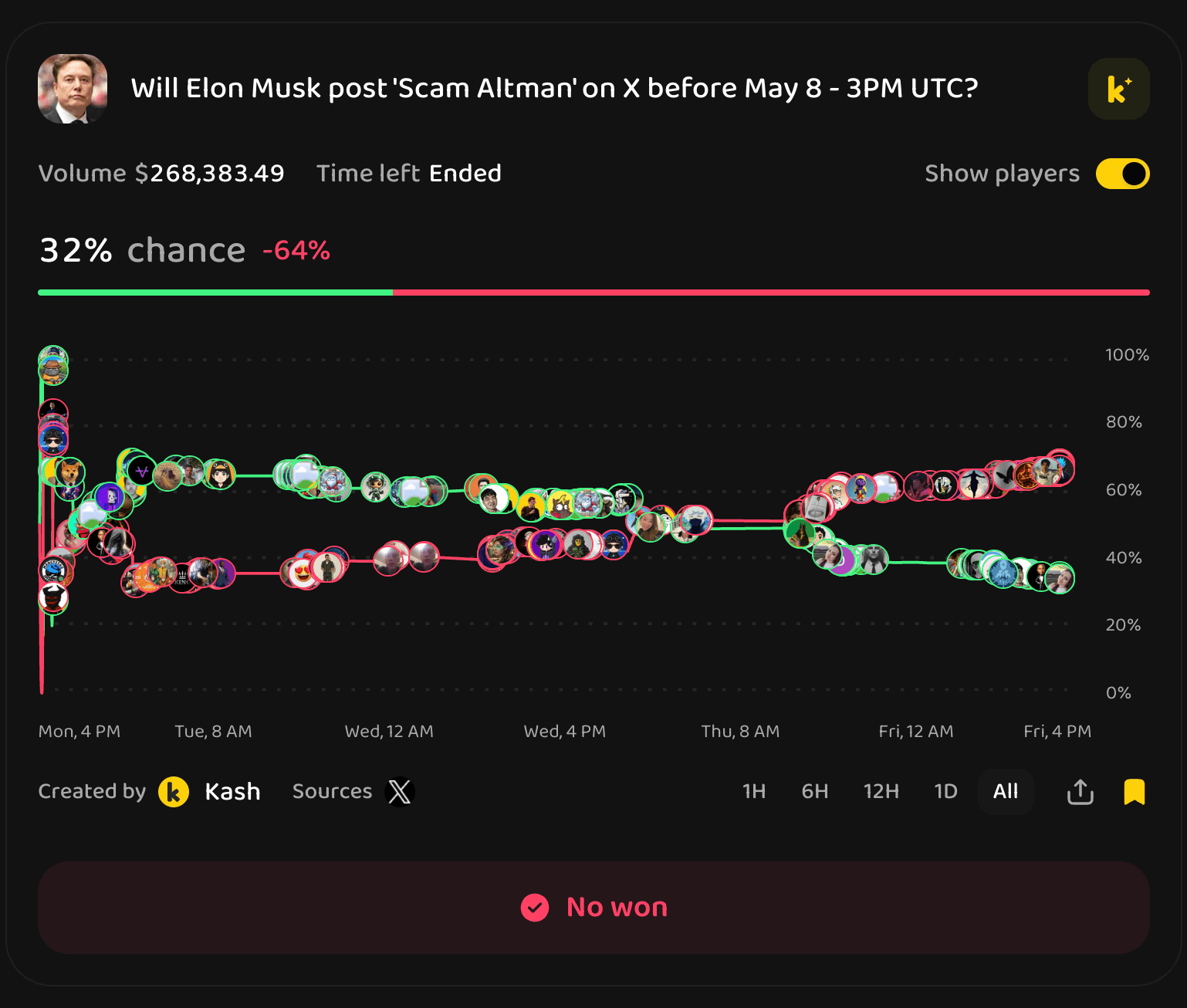
It wasn't a serious question. It was a meme, the kind of half-joke that lives in a group chat for five minutes and dies. Except this time, somebody asked us to make a market out of it. By the time the deadline arrived, 179 strangers from 23 countries had locked in $268,000 worth of predictions on whether Elon would post the phrase. 335 trades. The biggest market of the week.
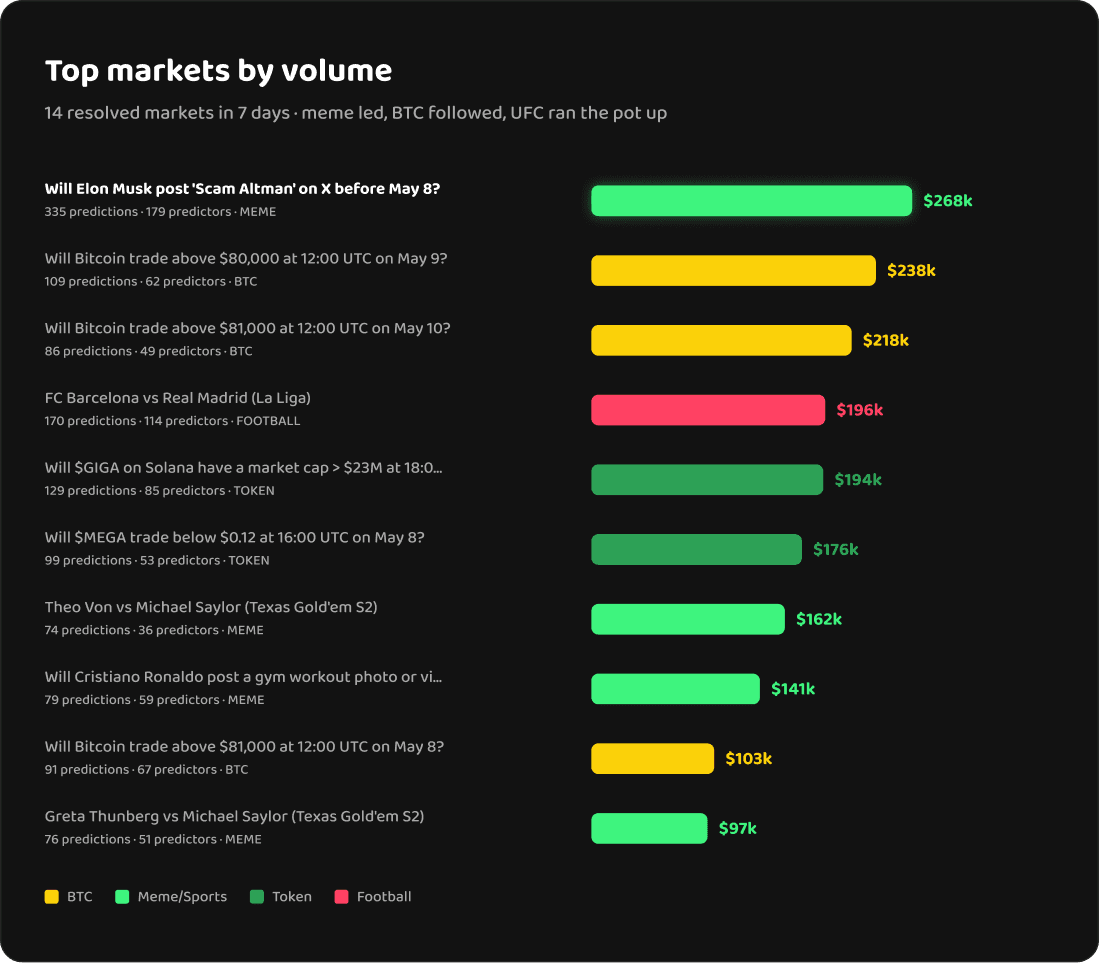
That market shouldn't exist. No editorial team would have priced it. No professional market maker would have quoted both sides. The spread on a manually-quoted version of this question would have been so wide that nobody would have traded. But it did exist, the prices were fair, and 179 people walked away with positions on it.
Here's the framing that was confirmed for us over the week: Polymarket is a trading venue. Kash is a social primitive for expressing conviction. Different category, different surface, different user. A trading venue lives in a tab nobody opens. A social primitive lives in the feed where the take already happens.
The World Showed Up
Before launch we had a thesis: take the 99% of people who don't use prediction markets (people who argue in group chats, post takes on X, and second-screen every match) and give them them a way to put their conviction on record without learning what a wallet is. Quote tweet to predict. That's the whole flow.
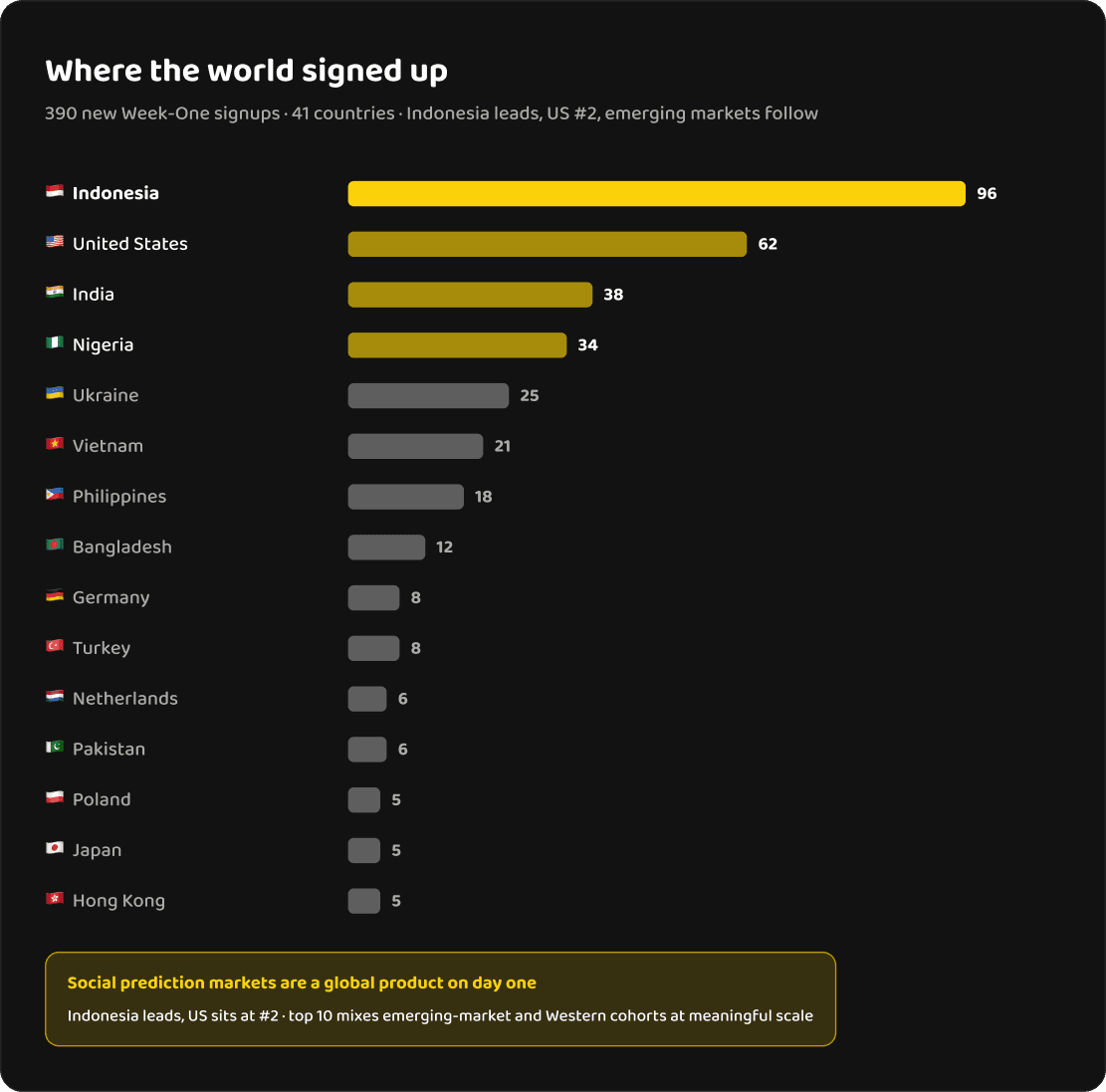
Social-native prediction markets are a global product on day one. Indonesia leads at 96, the US comes in second at 62, then India, Nigeria, Ukraine, Vietnam, Philippines, Bangladesh. The conviction economy isn't bound by geography.
The other number from the funnel that mattered: 59% of Week 1 signups placed at least one prediction. 23% placed five or more. Most prediction-market platforms see fewer than 30% of new wallets ever execute. It’s testnet, so behaviour will evolve, but the signal matters.
The Scam Altman Market
Back to that question. The market opened Wednesday afternoon. By 3 PM Friday (48 hours later) it had pulled the largest crowd of the week. Two-thirds of the predictors said no, Elon wouldn't type the phrase. A third said yes.
When the deadline passed without the post, the crowd that called "no" got paid. $0.78 per share for the winning side, 110 winners paid out. The math worked perfectly. The on-chain settlement transactions all confirmed.
What made this market matter wasn't the volume. It was the possibility of existence. A meme question, in a feed, priced by 179 strangers, settled in less than two days, requested by the community itself.
About that last bit: permissionless market creation isn't live yet. Our team still curates the listings. But Week 1 taught us something we didn't fully expect: the requests are stacking up. Discord and Telegram are full of users telling us what they want priced: flight delays, specific tweets that may or may not happen, micro-narratives from football matches we haven't even heard about yet.
They don't need us to write the question. They need us to get out of the way. Kas is the first protocol that will enable that without users having to provide upfront liquidity. More about the math behind our custom bonding curve AMM later.
The Leaderboard, And Four Ways To Climb It
The official Week 1 scoring is simple: points = title multiplier x realised PnL + awards (like highest accuracy of the week)
Realised PnL is the base. The title multiplier is a small bonus (~3%) for users with status badges like Founding Predictor, granted to top-100 beta members (kashflash).
What's interesting isn't the formula. It's the playbooks that got people there.
# | Trader | Playbook | Trades | Volume | Comp PnL | What made them stand out |
|---|---|---|---|---|---|---|
1 | @Dailychainn | swing player | 50 / 56% acc | $181k | +$47,535 | $MEGA position alone netted +$35,505 |
2 | @dantis__ | precision player | 78 / 100% acc | $346k | +$41,264 | Every resolved call on the right side, full season |
3 | @Eduardonchain | volume play | 92 / 91% acc | $510k | +$24,613 | Most volume on the platform by a wide margin |
4 | @banhur299465 | one-shot | 1 / 100% | $10k | +$16,747 | One read, walked: $10k in → $16,747 out |
Five more users in the top 20 ran the same single-call one-shot playbook as @banhur299465.
The leaderboard formula doesn't care which playbook you ran. Swing one $35k MEGA call, grind out 78 perfect predictions, push half a million in throughput, or land one $10k call at the perfect moment, the points are the points.
The Curve Did Something Beautiful
Most prediction markets pay $1 per winning share. Ours doesn't.
The bonding-curve AMM uses what we call reserve-splitting settlement, the entire reserve at resolution gets divided proportionally across the winning side's outstanding shares. Per-share payout is determined by how the crowd actually traded into and out of the market over its lifetime, not by a fixed contract.
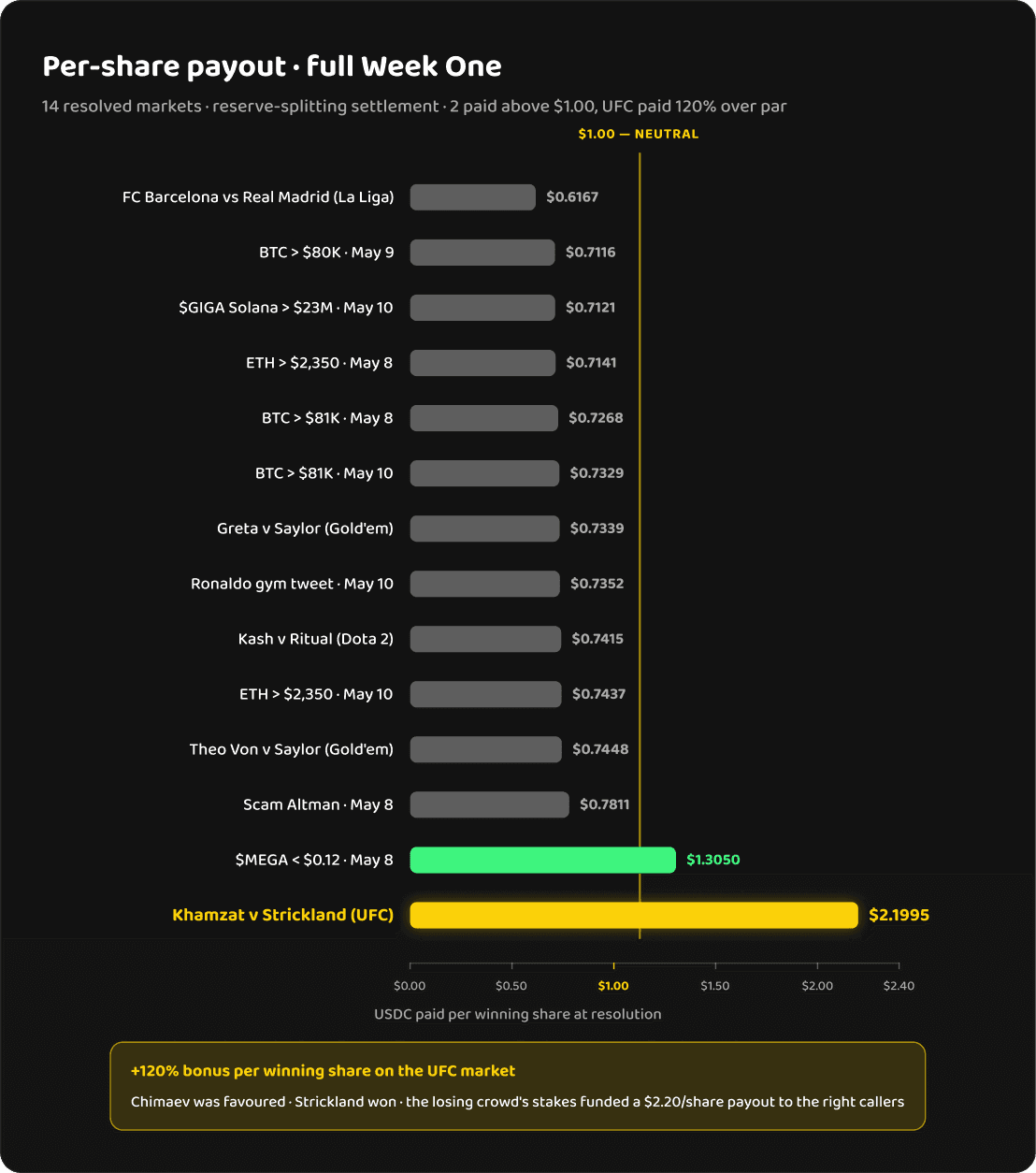
Per-share resolution values across 14 markets ranged from $0.62 to $2.20.
The standout is the UFC market: Khamzat Chimaev vs Sean Strickland on May 10. Chimaev held the consensus call through most of the market's lifetime. Late buyers piled into what ended up being the wrong side. When Strickland won, the right callers got paid $2.1995 per share, a 120% bonus on top of every share they held, because the losing crowd had paid into the pot at expensive prices.
The $MEGA market the week before told a smaller version of the same story: $1.305 per share, a 30% bonus to the right callers.
The crowd that gets the answer wrong doesn't just lose their stake, they fund the upside of the crowd that got it right. Order books can't do this naturally.
It's also what makes short markets possible. The median market lifetime in Week 1 was 21 hours. Same logic scales to 15-minute flash markets during a live match, hour long markets on a price candle, 30-minute markets on a debate moment.
The contract math matched the off-chain model to the cent on every resolved market. The on-chain layer is the part of the system we worry about least. Which brings me to the one place we did hit a ceiling.
The Week We Shipped, And The Week We Broke Things
389 commits across kash, webapp, and partner portal in six days: 108 new features, 135 bug fixes, 34 dedicated performance improvements. A selection of what landed, then everything that didn't.
What shipped
Bot Memory: @kash_bot now remembers you. Past predictions, near-misses, conversational style, it all feeds the next reply.
Realtime everywhere: Trades, positions, markets, notifications, PnL. All live, no refresh.
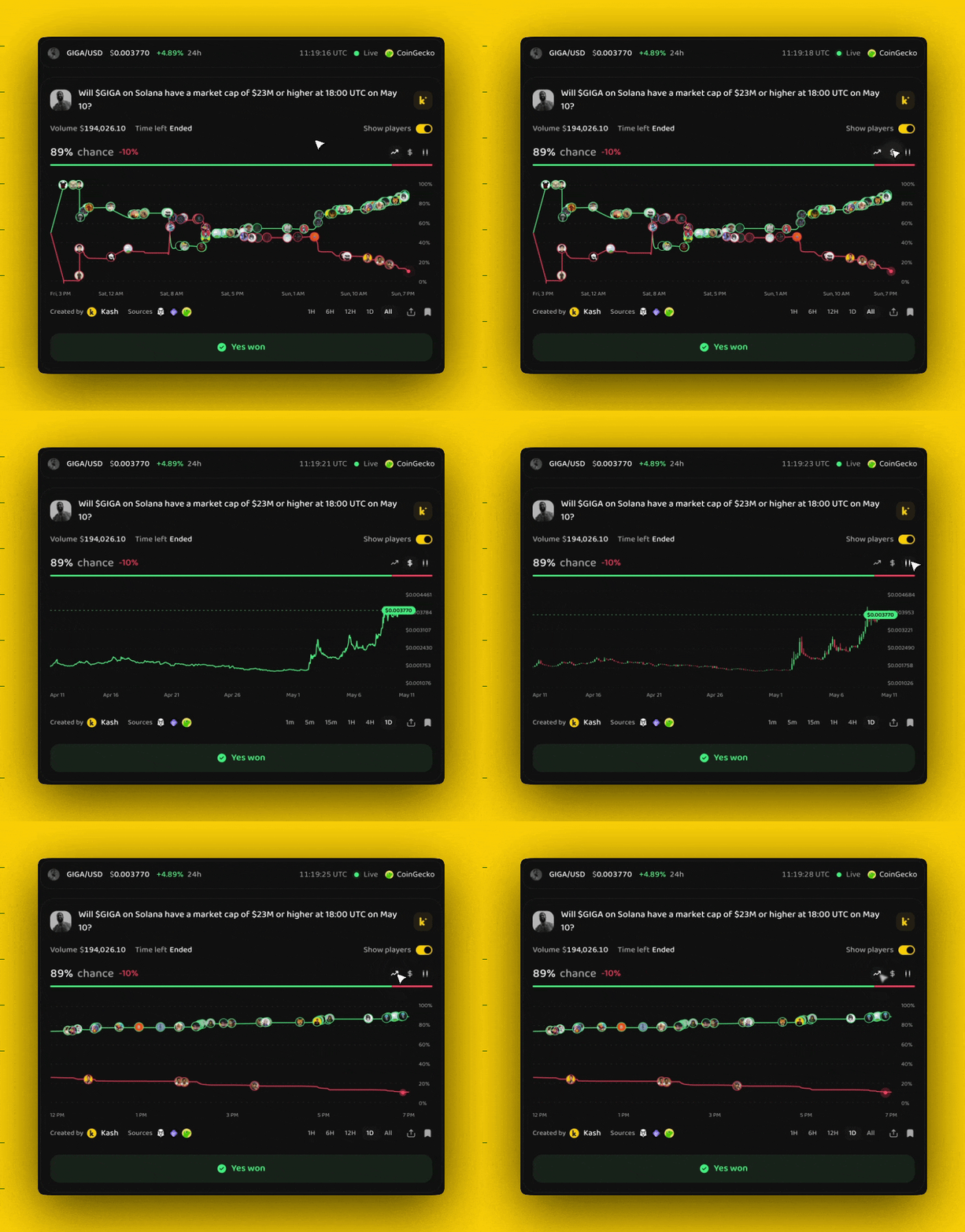
Prediction Price / Asset Price / Candles inside the market page: Crypto markets now have three chart tabs in the same header. Chance is the social graph. Price and candles stream from Binance. One market page, two questions a predictor asks: what does the crowd think and what is the asset doing.
What broke
Four surfaces. One real bug.
Protocol. No issues. The AMM math matched the off-chain model to the cent on every resolved market.
Microservice system. The payout batch limit. When the Scam Altman market resolved on May 8 with 112 winners, the payout orchestrator hit an upper limit on events per single batch, the worker silently dropped the queue. Other markets' payouts created in the same window processed fine. This one batch sat for a day.
✅ Fix shipped: payout batches now chunk past the threshold, so a single high-winner-count market can't trip the same wire again. All 112 winners settled, $343k flowed correctly.
Website. A couple display issues on P&L and leaderboard data.
✅ Fixes shipped daily within minutes of users reporting it.
Third-party dependencies. No issues.
The part of the system most likely to be irreversible if it goes wrong is the on-chain math. That part didn't go wrong. The off-chain plumbing hit a ceiling, we chunked the batches, the fix is live. We'd rather break in that order.
What We Know Now We Didn't Know On Monday
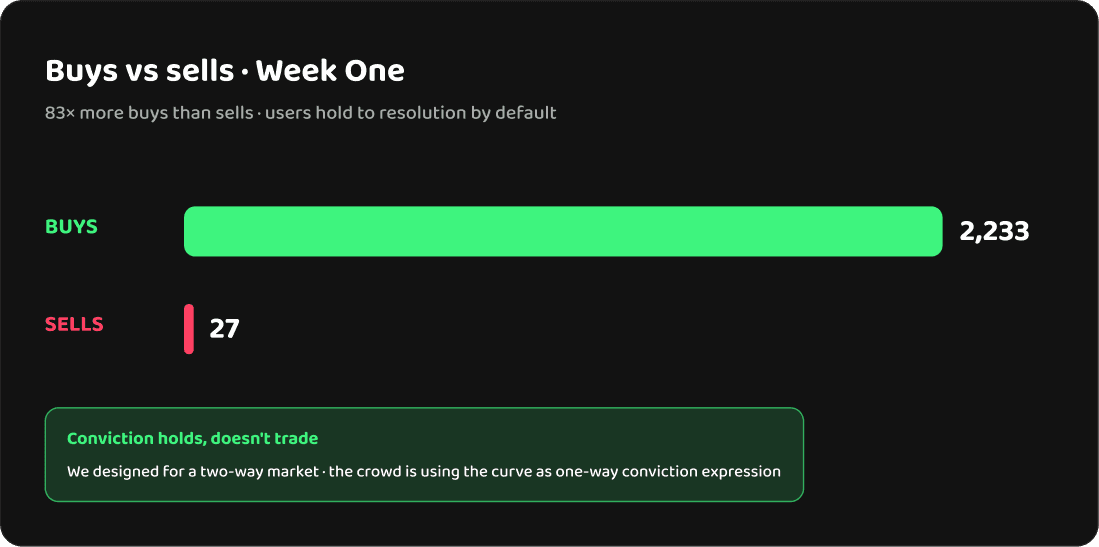
Sells are nearly nonexistent: 2,233 buys, 27 sells. Users hold to resolution by default. Either they don't realize they can exit, or the AMM's sell-side liquidity isn't appealing enough, or both. The crowd is using Kash as a one way conviction market.
The "late entry is free profit" intuition is wrong, and Week 1 has the receipts: A user complained that someone who entered five minutes before close at p=0.95 could "eat" the liquidity he'd provided 23 hours earlier. We pulled the data: that late entrant earned +1.3% in 18 minutes while the early predictor earned +3.7% over 17 hours. Late entry on the winning side gets worse per-dollar economics, every time.
The creator economy is the next gate: The 30% trading-fee revenue share for whoever creates a market ready to turn on and will be deployed on, mainet. The moment the gates open and a creator's audience trades the markets that creator wrote, the leaderboard gets a new column: how much you earned from the questions you asked.
The Week 1 Awards
3 awards for the cycle, each granting +3,000 leaderboard points:
Award | Predictor | Headline | Why they won |
|---|---|---|---|
🥇 Signal Leader | @Dailychainn | +$47,535 in the competition window | Highest score on the platform leaderboard. $MEGA position alone netted +$35,505, plus a sharp BTC > $82K call. 56% accuracy, but the wins were big enough to clear the field by $6k. |
💰 The Backer | @InvestSecrety | $5,000 → +$23,570 (+471% ROI) on $MEGA at p=0.291 | Placed 9 minutes before market close at 15:51 UTC on May 8th. Sized up deep against consensus when the crowd was pricing his side at a 29% probability. Largest single-trade profit of the week. |
🟡 Elite Predictor | @dantis__ | 100% accuracy across 78 trades, 33 markets | Every resolved call on the right side over the full testnet season. Not one spike, but sustained edge. |
The thing that surprised us most about Week 1 wasn’t the volume. It was watching hundreds of people show up to price internet culture in real time: meme questions, sports moments, tweets that may or may not happen, simply because the market existed in the same feed where the conversation already was.
That’s not a trading terminal.
It’s a new social object.
And we’re seven days in.
If you have a take on what happens next: back your words. Quote-tweet the market with your prediction, the side, and the amount. The market will be there.
Final top 10: competition window + award bonuses
Week 1 competition pool was $500, distributed across the final leaderboard standings based on realised PnL during the competition window, with additional point bonuses awarded for standout performance categories listed above, unlocked on mainnet. The pool will get bigger every week as the platform gets better and smoother, providing a fair playground for people to price how they see the world.
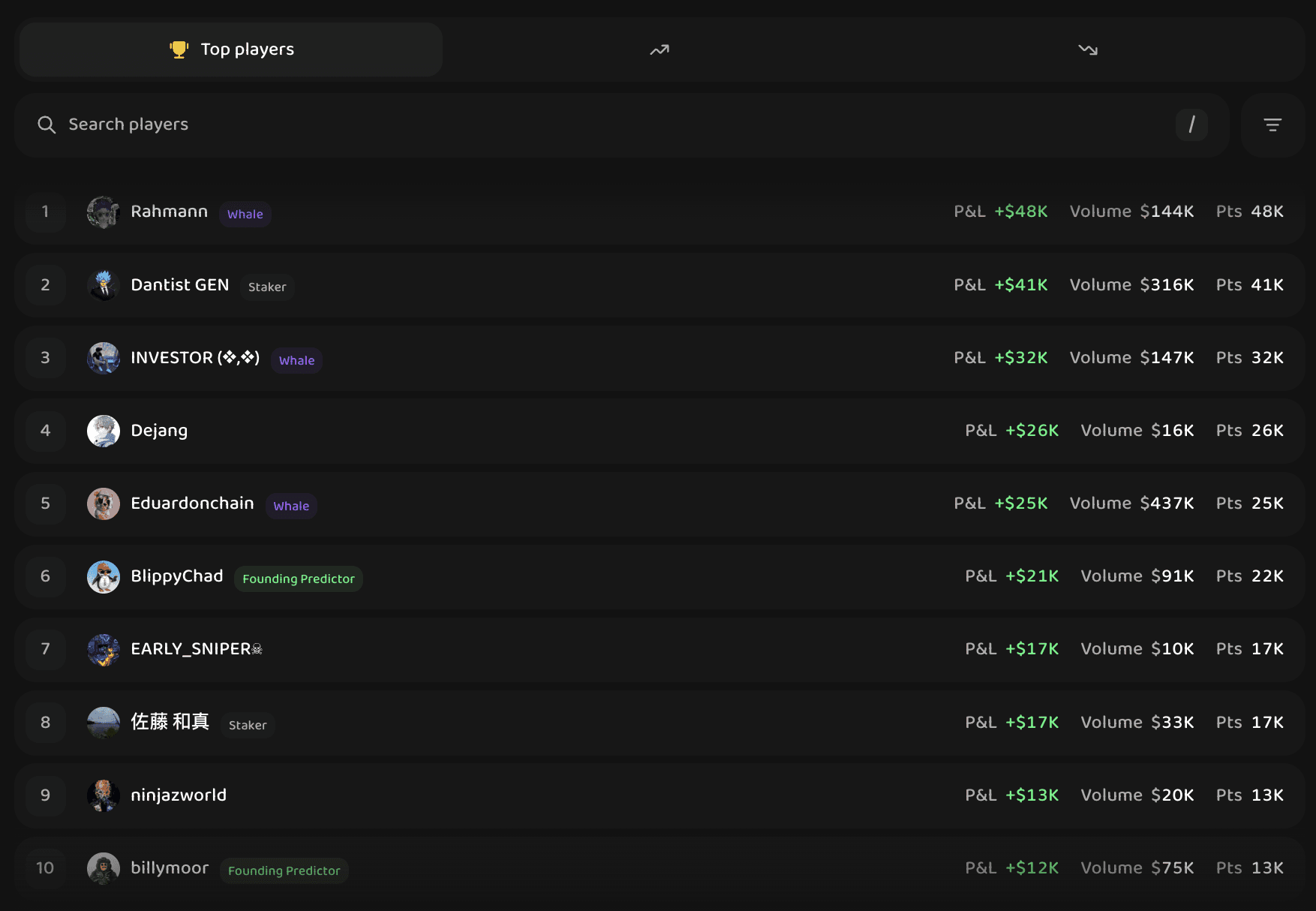
The final table ended up looking exactly like the product itself: different playstyles, different conviction profiles, different ways to climb. Some predictors grinded dozens of markets. Others sized into one trade and walked away. One predictor finished the week with perfect accuracy across 78 trades.
The system doesn’t reward a single style of trading. It rewards being right with capital behind the prediction.
And that’s ultimately the point of the leaderboard: not just tracking volume, but surfacing signal.

