Musk vs OpenAI Verdict: Six Predictions the Internet Is Pricing Wrong
TL;DR: Closing arguments in Musk vs Altman wrapped this week. Judge Yvonne Gonzalez Rogers' ruling could land any day. Everyone has a take. Almost no one can back it. Kash is a social-native prediction market built on X where users quote-tweet @kash_bot to forecast exactly these kinds of fast-moving, behavioural questions: Will Musk keep posting? Will OpenAI IPO on schedule? Does Altman survive?..; that traditional platforms can't list fast enough. Below: six contrarian leans and the receipts worth holding.
[Last updated: May 14, 2026]
Closing Arguments Are Done. The Internet Is Not.
Elon Musk is suing OpenAI for up to $150 billion.
Sam Altman just spent two days insisting everything is fine.
Judge already told Musk to stop posting. He did not stop posting.
Anon is quote-tweeting clips from federal court saying "this changes everything" with the confidence of a man who has not read the filing.
You already have a take. Almost no one will back it. That's the gap.
Traditional prediction markets can't list "Will Musk post within an hour of the ruling?" fast enough. Kash can. That's the whole point of @kash_bot. Permissionless, 30-second market creation, trade by quote-tweet, resolves automatically.
Six unresolved questions. Six leans. Six places the consensus is wrong.
The Internet Has Been Trading This in Its Head for Three Weeks
The actual case underneath the discourse:
Musk co-founded OpenAI in 2015 as a nonprofit. He left the board in 2018 after a governance fight that Altman's testimony now reframes as Musk allegedly demanding a 90% equity stake. Read that again.
OpenAI completed its corporate restructure in late October 2025. The nonprofit (now the OpenAI Foundation) is reportedly described as holding equity worth around $130 billion in the new for-profit, OpenAI Group PBC. Microsoft is described as holding a stake around 27%, with technology rights through 2032.
Musk argues the restructure killed the original mission. OpenAI's defense, roughly: you knew, you posted about it years ago, you only sued after launching a competitor. Exhibit A is his September 2020 tweet calling OpenAI "essentially captured by Microsoft". That's the statute of limitations argument doing the heavy lifting.
That's the scoreboard. Now the six questions everyone is already pricing in their head.
1. Will Musk Actually Win the Lawsuit?
Trial began April 27, 2026 in U.S. District Court, Northern District of California. Musk testified across multiple days. Altman testified May 12 and 13, saying the nonprofit was "left for dead" after Musk's exit. Closings wrapped this week. Ruling within days.
Musk's emotional argument is strong: a lot of people genuinely think OpenAI went from "open nonprofit" to "extremely closed mega-corp" suspiciously fast. The legal standard is the problem. Courts do not enjoy undoing billion-dollar companies. Altman's "Musk wanted 90%" testimony, if the judge buys it, ends the stolen-charity framing in one sentence.
Lean: Musk loses the headline. Split outcome more likely. OpenAI keeps the structure, Musk gets narrower concessions, both sides claim victory on X inside the hour. The social outcome may outrun the legal one. Receipts do not appeal.
2. Will Musk Stop Posting Through the Trial?
Judge already asked both sides to stop attacking each other online. Musk responded by flying to China with Trump, mid-trial, after the judge told him he wasn't excused.
This is not a serious question.
Lean: He will not, in fact, stop posting. The judge warnings are the content cycle. By the time the ruling drops there will be a Kash market on whether Musk posts within 60 minutes of it. Polymarket will still be reviewing the submission.
3. Does OpenAI Still IPO on Schedule?
OpenAI reportedly raised at roughly an $852 billion valuation in early 2026. Industry reporting has described monthly run-rate revenue around $2 billion. CFO Sarah Friar is said to be targeting a regulatory filing in H2 2026, with a listing window reportedly slipping from late 2026 toward 2027.
Not asking "is AI important?", that take has been filed. The IPO question is whether public markets buy that the governance is stable, the Microsoft tie is stable, the legal overhang is priced in, and the economics eventually close.
Lean: Plausible by late 2026 or 2027. Bumpier than it looked six months ago. The lawsuit lives in the S-1 through appeals regardless of who wins (OpenAI will be legally required to disclose the Musk vs Altman case in the Risk Factors section of their IPO filing). If public markets endorse this structure and valuation after this trial, the next decade of AI labs gets built the same way.
4. Can xAI Catch OpenAI After the Distillation Admission?
OpenAI still appears to lead on compute. Then April 30: Musk testified under oath that xAI "partly" distills OpenAI's models to train Grok, calling it "standard practice to use other AIs to validate your AI." That appears to conflict with OpenAI's stated terms. CT did not handle this gracefully.
Compute is a moat. It is not the only moat. The actual question is whether xAI can ship products people like while spending less.
Lean: OpenAI keeps the compute lead. The capability gap narrows anyway. The thing nobody is pricing: X itself. A live firehose of human conversation wired into your AI platform is strategically weird and quietly very powerful — especially as real-time context starts mattering more than another fine-tune nobody asked for.
5. Is Sam Altman Still CEO at the End of 2026?
Altman already survived one of the wildest executive crises in tech history in 2023. Came back stronger. Investors aligned, products keep growing, OpenAI owns the AI conversation.
Replacing a CEO during a trial and before a possible IPO is something companies do only when they have no choice. They have a choice.
Lean: Altman stays. Absent a fresh crisis, the path of least resistance keeps him in the chair through the listing. The "quiet CEO" playbook gets copied, every founder who watched Musk post his way into this trial just got a free case study.
6. What Happens to the Trial in the Court of Public Opinion?
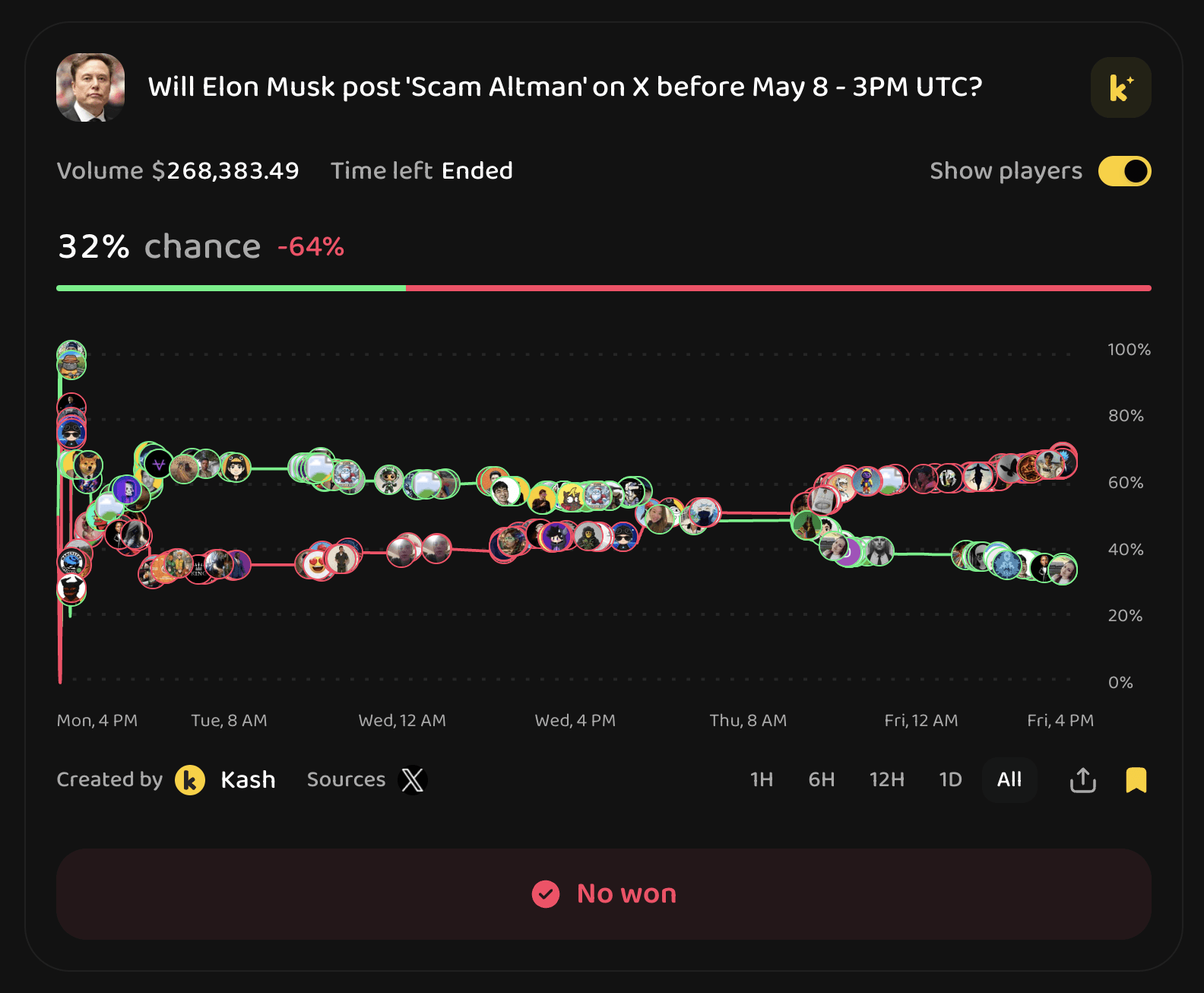
The internet has spent three weeks litigating Musk v. Altman in parallel with the actual judge. "Left for dead." The alleged 90% equity demand. The distillation admission. The "Scam Altman" tweets.
Lean: By the time the judge rules, the timeline has settled it twice. The Fade mechanic exists for exactly this, when a confident take is wrong, one click takes the other side, and your quote-tweet spreads the receipt.
Where to Forecast the Musk vs OpenAI Verdict: Platform Comparison
Feature | Polymarket | Kalshi | Kash |
|---|---|---|---|
Interface | DeFi trading terminal | Finance-native terminal | Your X feed |
Trading mechanic | On-chain order book | Limit orders | Quote-tweet @kash_bot |
Market creation | Manual approval | Curated only | Permissionless via the Kash app |
Creator revenue | None | None | 30% revenue share |
Coverage | Major outcomes | Approved events | Any narrative, including behavioural micro-markets |
Social integration | Link share | Link share | Native to the X conversation |
Settlement | On-chain | Centralised | On-chain settlement (automatic) |
What This Actually Means
OpenAI probably survives structurally intact. Musk keeps attacking publicly anyway. xAI stays competitive while spending less. Altman stays CEO. The feud continues. None of that is shocking. It might be the entire point.
The case ends up mattering less for damaging either company than for normalising a new template: nonprofit origin story, massive commercial scale, permanent public controversy, constant social-media warfare. That's the industry now.
Most of the questions people actually care about aren't finance questions. They're behavioural. Legacy markets are too slow. Kash markets settle in your feed, and print the public receipt that you called it.
You probably already have a take on how this ends.
The only question is whether you're going to leave a receipt.
FAQ
When is the Musk vs OpenAI verdict expected?
Closing arguments wrapped the week of May 11, 2026. The advisory jury and Judge Gonzalez Rogers' binding ruling are expected within days. Because the case is being tried in equity, the judge issues the binding decision after weighing the jury's recommendations.
How much is Musk seeking in the OpenAI lawsuit?
Reports indicate Musk's team is asking the court to disgorge up to $150 billion back to the nonprofit entity, with a January filing reportedly citing up to $134 billion in alleged "wrongful gains."
Did Musk really admit xAI distilled OpenAI's models?
Yes. On April 30, 2026, Musk testified under oath that xAI "partly" distills OpenAI's models to train Grok and called it "standard practice to use other AIs to validate your AI".
Is OpenAI still going public in 2026?
Industry reporting suggests the original Q4 2026 IPO target has slipped toward 2027, though CFO Sarah Friar is reportedly targeting a regulatory filing in H2 2026. The lawsuit overhang is one of several factors.
What is a flash market on Kash?
A flash market is a prediction market created in real time around a viral moment. A court ruling, a CEO statement, a leaked memo. On Kash, any user can create one in 30 seconds through the app, and the market creator earns 30% of the fees generated by their market.

