Display Ad Is Flat. Engagement Is at Record Highs. Here's What Replaces the Model
TL;DR: The audience has never been more engaged, and the dominant monetisation model captures less of that engagement every year. Global CTR collapsed from 2.1% in 2000 to 0.35% in 2025. 86% of users experience banner blindness. Ad blockers cost publishers $54 billion annually. Meanwhile time spent on platforms, session intensity, and active participation are at record highs across 5.56 billion global users. The ad market is quietly bifurcating: formats that price some signal of user state (engaged viewing, purchase intent, query intent) are compounding, while flat-impression formats are in structural decline. Social prediction markets add a fourth signal to the list: conviction. On Kash, that signal gets a transaction layer dropped directly into the social feed, scaling revenue with how much users care and returning 30% of fees to the partner platform.
[Last updated: April 20th, 2026]
The Disconnect in the Data
For a decade, every executive in digital media has been told the same story: attention is the asset. Build it, and the money follows. The attention is now built. The money hasn't followed.
The headline makes the ad market look healthy. US digital ad spend grew 11.4% to just under $300 billion in 2025. Its highest total ever.
Look underneath and the picture inverts.
Display prospecting CPMs fell 11% year-over-year in early 2026. Publisher web traffic dropped between 20% and 90% in 2025 as AI-powered search replaced direct clicks. European publisher display advertising fell 2% in Q1 2025 while subscription revenue grew 21.8%. The global average click-through rate for display ads has collapsed from 2.1% in 2000 to 0.35% in 2025.
86% of internet users experience banner blindness. Roughly 31.5% (over 900 million people) run ad blockers globally. The annual cost to publishers is $54 billion.
Now look at engagement.
Global social media users hit 5.56 billion in 2025, 63.9% of the world's population. Users spend an average of 2 hours 23 minutes on social platforms every day. TikTok average session times exceed 60 minutes. The average person actively uses 6.8 different platforms a month. User-generated content, comment volume, and creator output are all at record highs.
The conclusion is uncomfortable. The audience is more engaged than ever. The dominant monetisation model captures less of that engagement every year.
Why the Model Broke
Display advertising was built for a scarce commodity: attention.
In 1999, a banner ad was interesting. By 2005, it was ignored. By 2015, it was blocked. By 2025, it is invisible. Not because it isn't served, but because the human visual system has evolved to filter it out before it registers.
The industry's response has been to find new inventory. Native ads. Programmatic. Connected TV. Retail media. Each new format is an attempt to place an impression somewhere the brain hasn't yet learned to ignore.
The problem isn't that advertising stopped working. It's that advertising prices the wrong thing.
Display monetisation is static. The same CPM whether a user is deeply engaged or scrolling past. A 20-minute session pays roughly the same per minute as a 20-second bounce. The most valuable moments in a user's relationship with a platform — the comments, the reposts, the debates, the repeat visits, are all priced identically to the least valuable moments.
Engagement intensity has no pricing mechanism under the display model. That isn't a flaw that can be fixed with better targeting. It is the definition of the model.
The Formats That Are Actually Growing
Look at where ad spend is compounding and a pattern appears.
Connected TV grew 28% year-over-year in 2025, a format where viewers are actively watching, not passively scrolling. Retail media is one of the fastest-growing ad categories globally, a format where the ad sits next to a transaction the user is already intending to make. AI search is emerging as a new ad surface where placement is tied to user intent rather than user presence.
Every growing format shares a property the declining formats lack: pricing responds to something specific about user state. CTV prices engaged viewing. Retail media prices purchase intent. AI search prices query intent. What they share is that a flat impression no longer pays the same as an engaged one.
The market has voted. Formats that price user state (attention quality, purchase intent, query inten) are compounding. Flat-impression formats are in structural decline. Prediction markets add a new signal to the list: conviction.
The Layer Every Growth Format Still Misses
Here is what every winning format has in common, and what none of them fully solve.
Connected TV monetises engaged viewing. It doesn't monetise the conversation happening on X about what's being viewed.
Retail media monetises purchase intent. It doesn't monetise the opinion forming around a product before purchase.
AI search monetises query intent. It doesn't monetise the debate happening about the answer.
In each case, the format captures a slice of engagement. The largest slice (the social conversation and opinion-formation that drives everything else) remains unmonetised.
That is the layer prediction markets capture.
Not every opinion is a financial event. Most users will never stake their views and don't want to. But a meaningful share of engaged users already do: in fantasy leagues, in group chats, on prediction platforms that require them to leave their social feed entirely. That behaviour is documented and growing. No format has built infrastructure for it inside the feed where the conviction actually forms.
The users who would stake their opinions currently post them for free. The platforms that host the conversation capture none of the conviction the conversation generates. That is the specific, addressable subset, not universal opinion formation, but the convertible portion of it that existing formats have no way to reach.
A social-native prediction market is the mechanism for that subset.
What This Looks Like in Practice
A publisher runs a political analysis article on a close upcoming election.
Under the display model, the article generates CPM revenue on impressions. A highly engaged reader who spends eight minutes with the piece, reads every comment, forms a strong opinion, and shares it on X is worth roughly the same per impression as a reader who bounces in four seconds. The conviction the article produced is the single most valuable thing about the interaction and it is priced at zero.
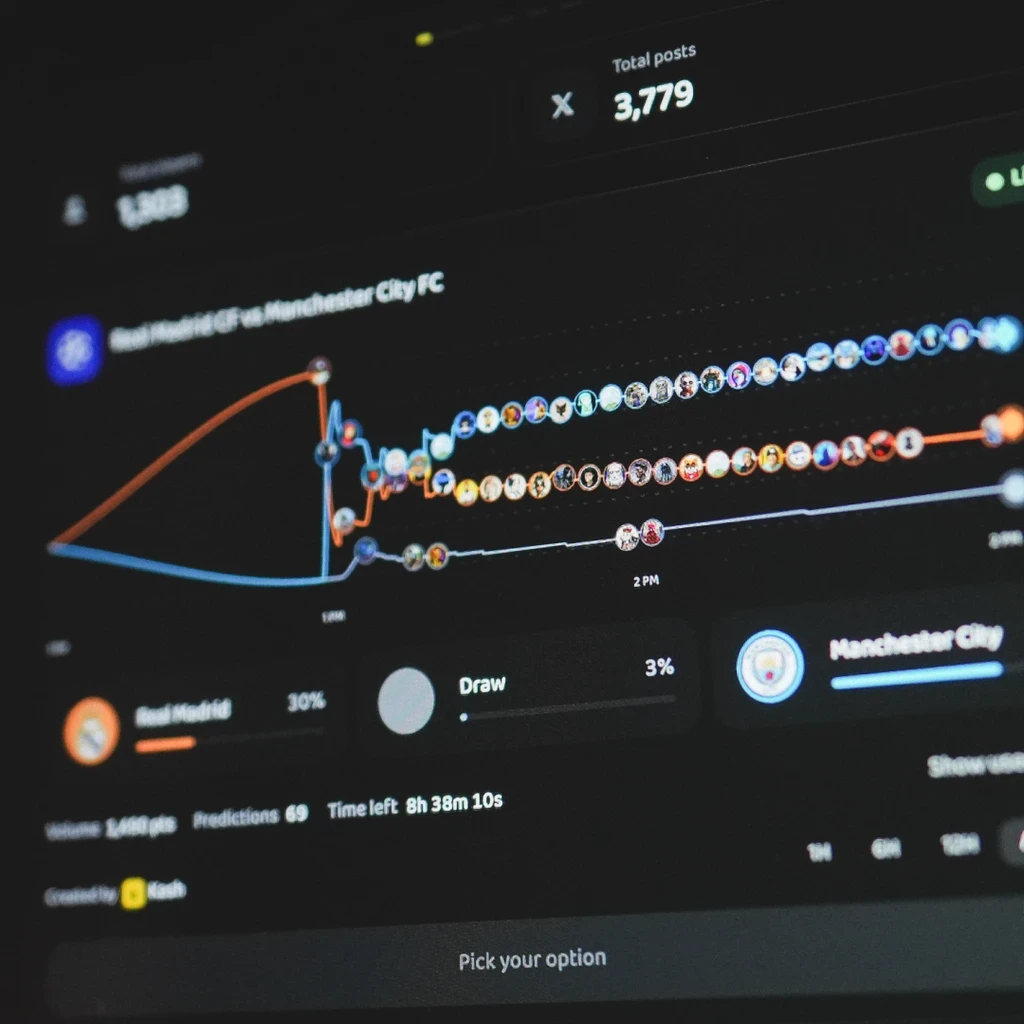
Under a transaction layer running on Kash, the same article carries a social-native prediction market on the outcome it analyses. Engaged readers stake positions via quote-tweet on X. Every prediction is simultaneously a social post to the reader's own network. Readers who disagree fade the call, generating their own distribution. Markets settle on-chain through a decentralised AI oracle. The publisher earns 30% of fees on every position taken on markets created around their content.
The same article now generates two revenue streams, one static on impressions, one dynamic on conviction. The second stream scales directly with how much of the audience cared enough to stake what they just read.
Why Existing Engagement Fixes Don't Close the Gap
The industry has tried several responses to this disconnect. None of them price conviction.
Subscriptions grew 21.8% for publishers in Q1 2025 and are a critical diversification, 77% of commercial publishers are prioritising them in 2025. But subscription revenue caps at willingness-to-pay for access. It doesn't compound with how much a subscriber engages once through the paywall.
Native ads and branded content re-dress display with better creative. Engagement rates improve marginally. The underlying pricing (per impression, per placement) is unchanged.
Tipping and creator-direct revenue work for the top 1% of creators with devoted audiences. They do nothing for the long tail of engaged users whose value comes from volume, not depth of single-relationship giving.
Attention-based programmatic pricing prices attention better but still prices impressions. The underlying asset is the same. Better measurement doesn't change the asset class.
None of these close the structural gap. They all price presence. None of them price conviction.
Display / Programmatic | Subscriptions | Native / Branded Content | Social-Native Prediction (Kash) | |
|---|---|---|---|---|
Scales with engagement intensity | ❌ | ❌ (capped) | Marginal | ✅ |
Captures opinion and debate | ❌ | ❌ | ❌ | ✅ |
Platform revenue share | Net of intermediaries | Direct | Direct | ✅ (30% direct) |
Compounds through distribution | ❌ | ❌ | ❌ | ✅ |
Works inside the social feed | Partial | ❌ | Partial | ✅ |
On Kash, permissionless flash markets mean any live topic becomes a market in 30 seconds. Platform partners white-label the integration in 48 hours, keep 30% of every fee, and capture revenue directly proportional to how much their audience cares about what they are consuming. The display model isn't failing because advertising is bad. It is failing because the audience has stopped being passive, and the display model only works on passive audiences.
FAQ
Isn't digital ad revenue still growing overall?
Total US digital ad revenue grew 11.4% in 2025 to nearly $300 billion. But the growth came almost entirely from formats that didn't exist five years ago: Connected TV, retail media, and AI search. Traditional display advertising is flat or declining for most publishers. The headline masks a structural bifurcation inside the category.
Aren't subscriptions already solving the problem?
Subscriptions are an essential diversification and grew 21.8% for UK publishers in Q1 2025. But subscription revenue caps at willingness-to-pay for access. It does not scale with how much a subscriber engages above the paywall. A reader who consumes 100 pieces pays the same as a reader who consumes 5. The ceiling is structural.
What does "engagement intensity" actually mean for a platform?
It means revenue scales with something specific about what the user is doing, not just that they showed up. The ad market is already pricing multiple user-state signals: CTV prices attention quality, retail media prices purchase intent, AI search prices query intent. Display prices none of them. Prediction markets price conviction, the strength of an opinion a user has already expressed publicly. Every one of these signals beats flat-impression pricing, which is why every growing format has one and display has none.
How is a prediction market different from affiliate or commerce monetisation?
Affiliate and commerce models monetise intent to purchase. Prediction markets monetise the conviction behind an opinion a user has already expressed. The same user can generate multiple transactions a day across unrelated topics, not because they're buying anything, but because they are forming and backing views. It is a higher-frequency, lower-ticket version of the transaction layer.
What does deployment look like for a platform operator?
A white-labelled Kash integration takes 48 hours from brief to live markets. Market creation is permissionless: any platform user creates a flash market on any topic in 30 seconds. Settlement is on-chain via a decentralised AI oracle. The platform keeps 30% of every fee generated by markets created on their content.

